I research quantum computing. Most recently, I spent a summer at the National Security Agency working on classical decoders for Decoded Quantum Interferometry. Before that: quantum machine learning research with the RPI School of Science, cybersecurity research with the Rensselaer Cybersecurity Collaboratory, and a semester abroad at the Chinese University of Hong Kong.
Co-developed the blocked fast Walsh–Hadamard transform (BFWHT), an exact set-covering decoder for the low-weight binary closest vector problem, with CUDA/GPU implementations benchmarked on A100-class hardware. Built the end-to-end Decoded Quantum Interferometry (DQI) research codebase with interchangeable decoders and reversible resource estimation, and executed small circuits on IBM's 156-qubit Kingston system.
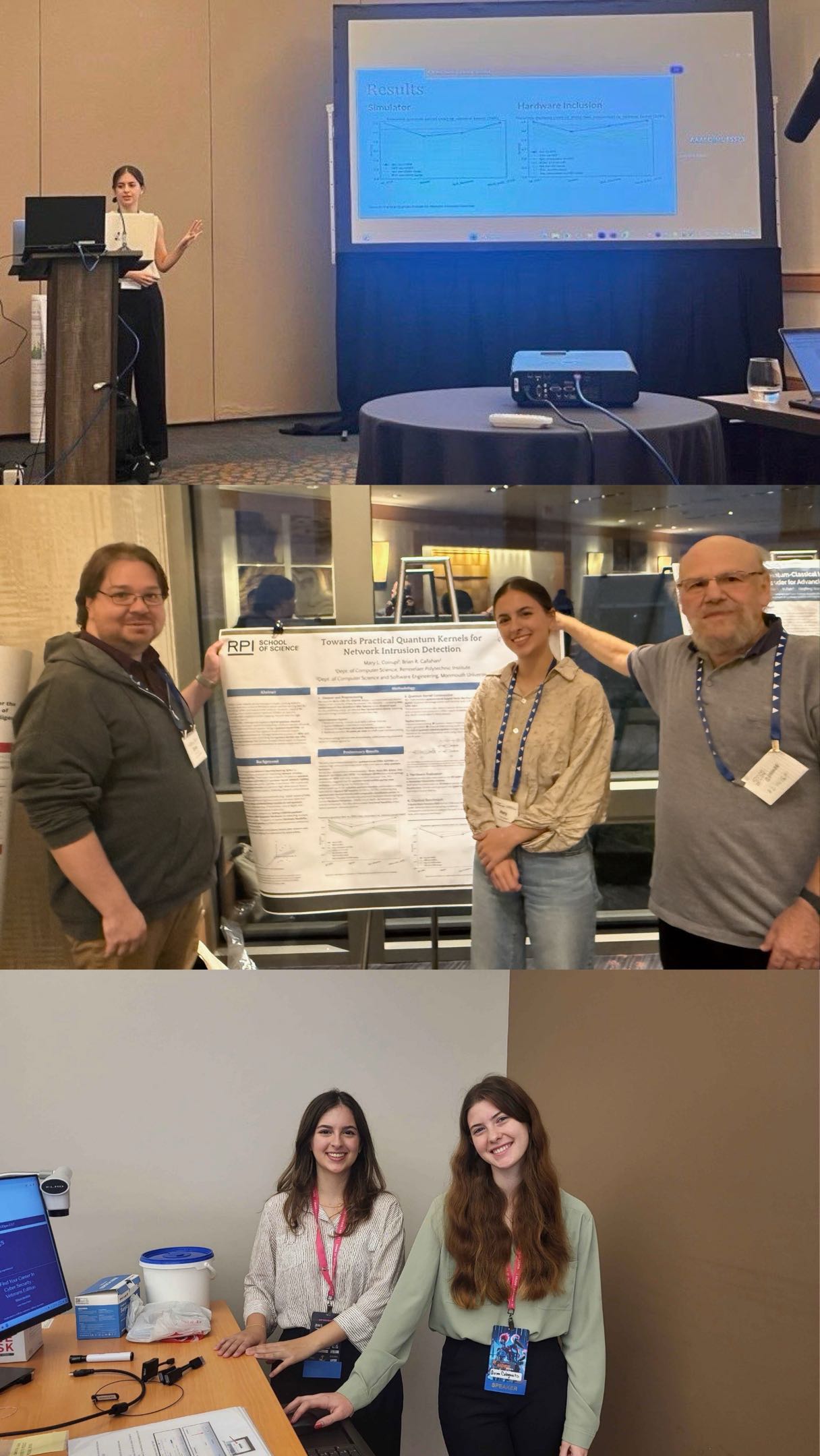
Designed a Qiskit quantum-kernel/SVM pipeline for network intrusion detection, achieving 85%+ accuracy on RPI's 127-qubit IBM Quantum System One. Built the reproducible QML-NIDS codebase and first-authored the resulting AAAI QIML proceedings paper.
Developed augmented-reality CTF challenges in steganography, DNS poisoning, and MFA bypass; coauthored a CISSE journal article and ASIA proceedings paper on generative AI and cybersecurity pedagogy.
Towards Efficient Low-Weight Decoding: A Blocked Fast Walsh–Hadamard Transform
Towards Practical Quantum Kernels for Network Intrusion Detection
A Case Study for Combating Student Overuse of Generative AI in Cybersecurity Education
RC3TF, an Augmented Reality CTF: Improving Cybersecurity Pedagogy for the Undergraduate Research Laboratory
Generative AI for Cybersecurity Awareness Training: Skills, Strategies, and Accountabilities
My name's Mary—I'm a computer science student at Rensselaer Polytechnic Institute, pursuing a B.S. (May 2027) with minors in Quantum Computing and IT & Web Science.
My research interests are quantum software, quantum error correction & decoding, NISQ algorithms, and high-performance computing—and I plan to continue into post-graduate study in quantum computing.
Site code lives at github.com/cotrum.
fun facts:
Custom (atypical) canvas sizes are available at an additional cost. Large works (>36") require a 25% upfront fee.
Email marycotrupi@gmail.com with questions or to make a commission request!